English


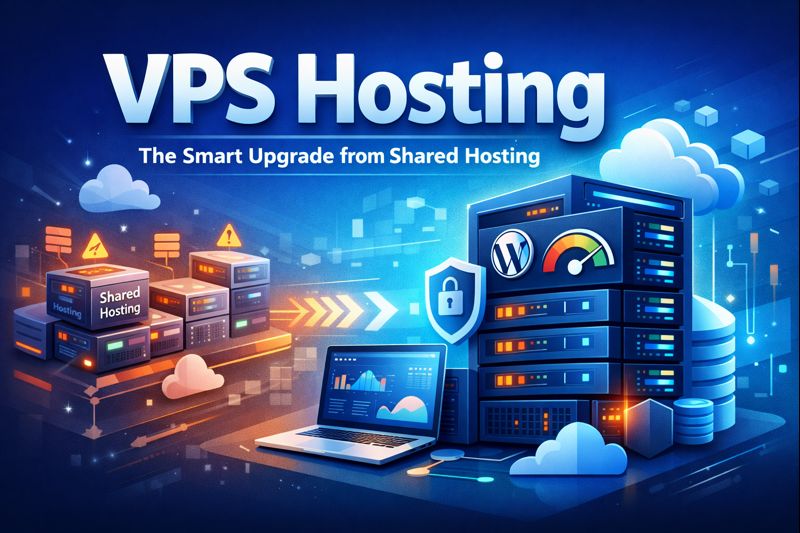
When launching a website, many users start with shared web hosting because it’s affordable and simple to manage. While this works well for small or personal websites, shared hosting often struggles to keep up as traffic, content, and functionality increase.
That’s where VPS (Virtual Private Server) hosting comes in. VPS hosting offers more power, control, and reliability—making it an ideal next step for growing websites.
What Is VPS Hosting?
VPS hosting uses virtualization technology to divide a physical server into multiple independent virtual servers. Each VPS has its own dedicated resources such as CPU, RAM, storage, and operating system.
Unlike shared hosting, where all websites compete for the same resources, VPS hosting provides a private environment that delivers consistent performance and greater stability.
VPS Hosting vs Shared Hosting
| Feature | Shared Hosting | VPS Hosting |
|---|---|---|
| Resources | Shared across many users | Dedicated to your VPS |
| Performance | Unpredictable | Consistent and reliable |
| Security | Shared risk | Isolated environment |
| Customization | Limited | High level of control |
| Scalability | Very limited | Easily scalable |
Benefits of VPS Hosting Over Shared Hosting
1. Improved Website Performance
With dedicated resources, VPS hosting delivers faster load times and smoother performance. Your website is not affected by traffic spikes or heavy resource usage from other sites on the same server.
Faster performance improves:
- User experience
- Search engine rankings
- Conversion rates
2. Enhanced Security
Shared hosting environments are more vulnerable because multiple websites operate on the same system. If one site is compromised, others may be affected.
VPS hosting provides isolation, reducing security risks and allowing you to implement custom security configurations, firewalls, and monitoring tools.
3. Greater Stability and Reliability
Because VPS resources are reserved for your use, your website benefits from higher uptime and fewer unexpected slowdowns. This is especially important for business websites that rely on consistent availability.
4. More Control and Flexibility
VPS hosting gives you administrative access, allowing you to:
- Install custom software and applications
- Configure server settings
- Choose your preferred operating system
- Optimize performance based on your needs
Shared hosting restricts these capabilities to maintain compatibility for all users.
5. Scalability for Future Growth
As your website grows, VPS hosting grows with it. You can easily increase CPU, RAM, or storage without moving to a new server or experiencing downtime.
This makes VPS hosting a long-term solution rather than a temporary fix.
6. Better Value Than Dedicated Hosting
VPS hosting offers many of the benefits of a dedicated server—performance, control, and security—at a significantly lower cost. It’s a cost-effective option for websites that have outgrown shared hosting but don’t yet require a full dedicated server.
Who Should Consider VPS Hosting?
VPS hosting is ideal for:
- Growing websites with increasing traffic
- Business and professional websites
- Online stores and membership platforms
- Developers needing more control and flexibility
If your website feels slow, unreliable, or limited on shared hosting, it’s a strong sign that VPS hosting is the right upgrade.
Final Thoughts
Shared hosting is a great starting point, but it comes with limitations that can hinder your website’s growth. VPS hosting bridges the gap between shared and dedicated hosting, offering better performance, stronger security, and greater scalability.
For website owners looking for reliability, speed, and room to grow, VPS hosting is a smart and future-proof choice.